How we build is changing rapidly. But the drive to create meaningful value remains the same. | Photo by Jodi B Photography
The new realities for product builders


There is a noticeable anxiety product managers have today. And it is even worse for product leaders. I felt it myself recently when speaking with our customers — and I think I understand it better now. I had the following revelation.
There is a version of product management that most of us learned and became pretty good at. You spoke with customers, defined the problem, worked with UX to design a solution, and handed requirements to engineering. You stayed close to the work and helped the cross-functional team get ready to launch. For most enterprise teams today, that is still roughly how things go — and it can produce good outcomes.
But we have new tools now and an unrelenting pressure to create value faster. We are asking ourselves how to update our established methodologies to be AI-assisted. And we are not really sure how. A former CPO of a major tech company told me they bought Mac minis for everyone on the product team and told them to "start using AI." But they did not explain how, or for what. Or how they should work together. This seems like a sign of panic to just do something, anything with AI.
I found comfort in the following realization: We need multiple working models for product development based on what we are building. One methodology is no longer enough. Many companies started years ago with waterfall, went to agile, and found a way to combine the two with a methodology like The Aha! Framework for product development. It incorporates a strategic approach with rapid iteration.
But we can no longer set a single best practice or framework to fit every situation. Instead, we need to start by asking, "What are we building?" and then apply the right approach, identifying how AI can assist along the way.
Multiple product development frameworks will soon exist within every meaningful enterprise. There will no longer be a single center of excellence or one approved way of working.
Start with what you are building
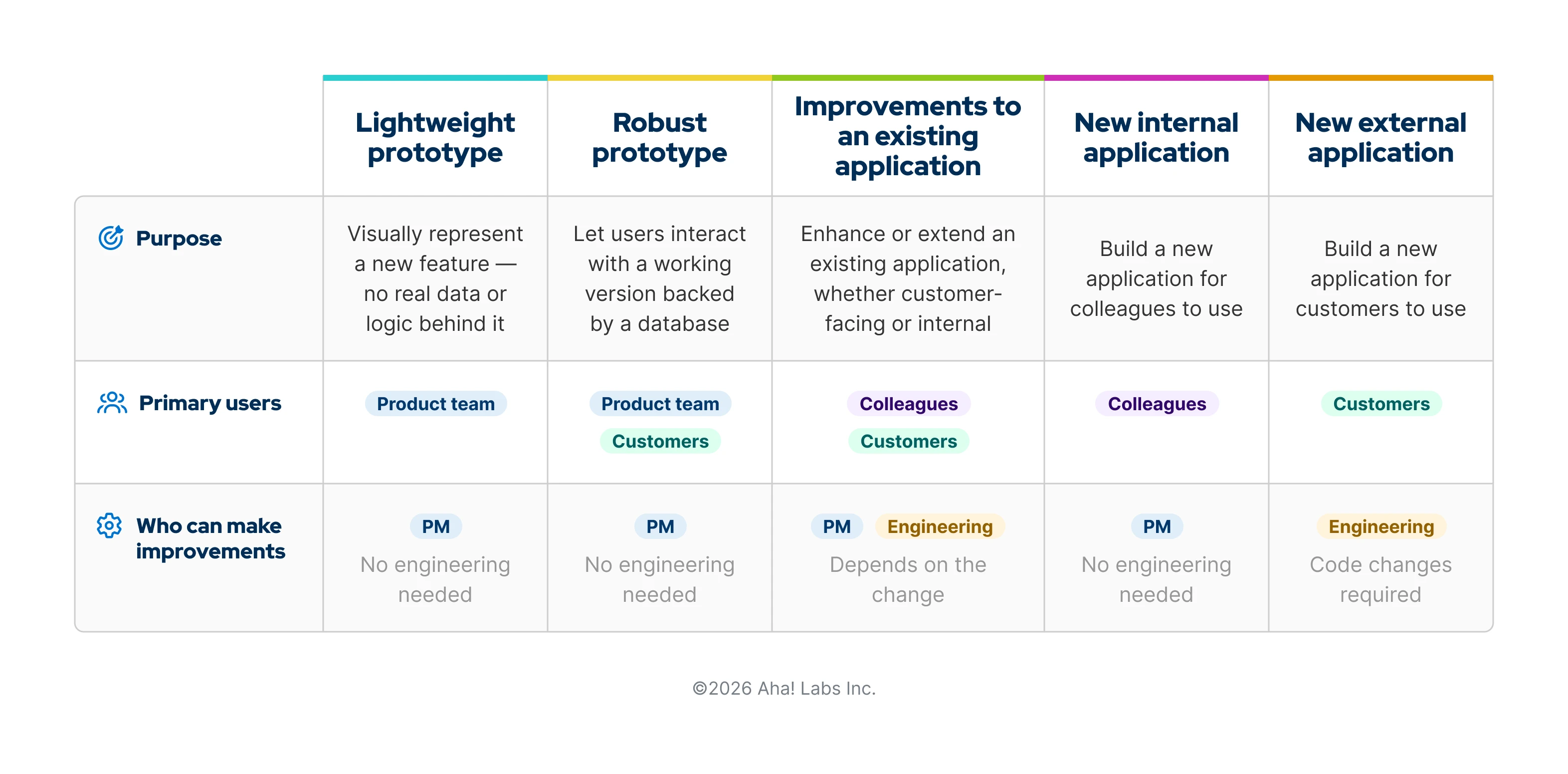
The answer to this question can range from lightweight prototypes to sparkling new applications. Different outputs should follow different paths depending on the purpose, who will use it, who can build it, and the tools available to you.
A large proportion of product development work will continue to focus on improving existing applications for external and internal use. These efforts require tight collaboration across product, UX, and engineering — just as they always have — augmented by AI to deliver updates faster. The same is true for new enterprise applications that are customer-facing, where complexity and scale still demand a more traditional approach.
But what about when we are building prototypes, or internal business applications, or lightweight customer tools? Independent "full-stack" product managers are now doing more building themselves. They can also create the internal applications that teams have needed for a long time but could not prioritize without engineering support.
This is why before answering how we should build, we must start with what we are trying to create.
Product managers are now builders. With AI, they can create everything from prototypes to robust applications.
Once you define the goal, you can choose the right path forward.
Match the method to the output
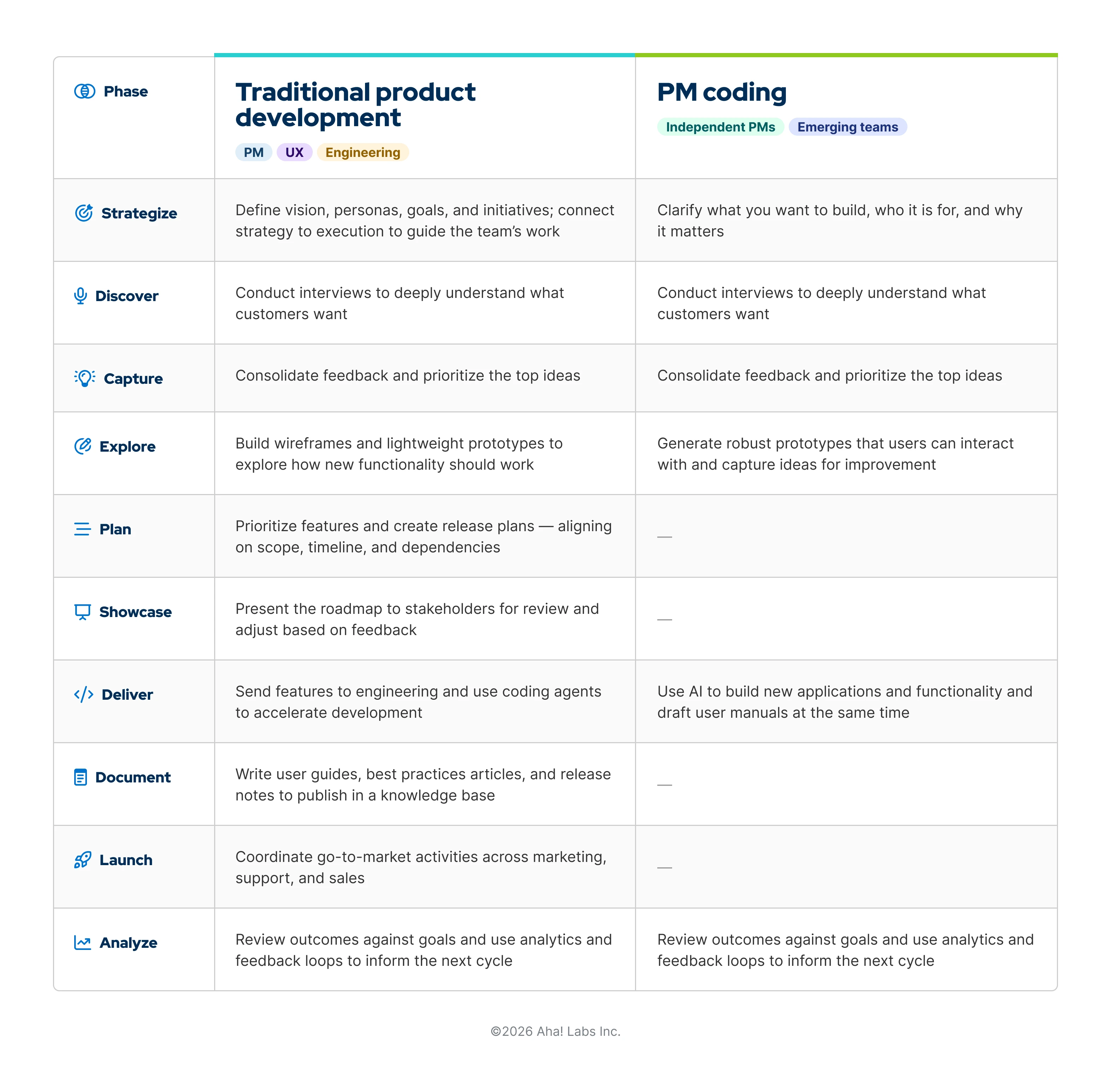
Most enterprise teams rely on a structured product development framework to guide how they build software today. It typically combines intentional planning with agile delivery across multiple phases — from setting strategy to analyzing outcomes. This works well for launching new products or delivering major functionality within existing ones.
But applying that same framework at all times for independent PMs and emerging teams does not serve the work. When a single product manager or small team is doing the building, many steps can be streamlined, combined, or removed entirely. You still define the strategy, gather feedback, and explore solutions. But you do not need the same level of cross-functional planning and handoffs required for a large release.
The table below compares a traditional approach with a more streamlined one. (I will share more details on this in a follow-up post.)
There are now multiple frameworks for building depending on what is being built and who is involved. Both are grounded in strategy and customer understanding.
Just because PMs are now builders who can use a lighter process does not mean you are working in isolation. It is still important to coordinate with teammates to provide a Complete Product Experience. And you can move dynamically between both frameworks.
Use AI to accelerate your work
Energizing this transformation is the power of AI. No matter what you are building or how you are building it, AI is a dynamic force. We are never returning to a world where it is not a key enabler of how we work.
What is possible with AI grows every month. It is not a stretch to suggest that even now, product managers are simply limited by their own imagination and what their company will allow.
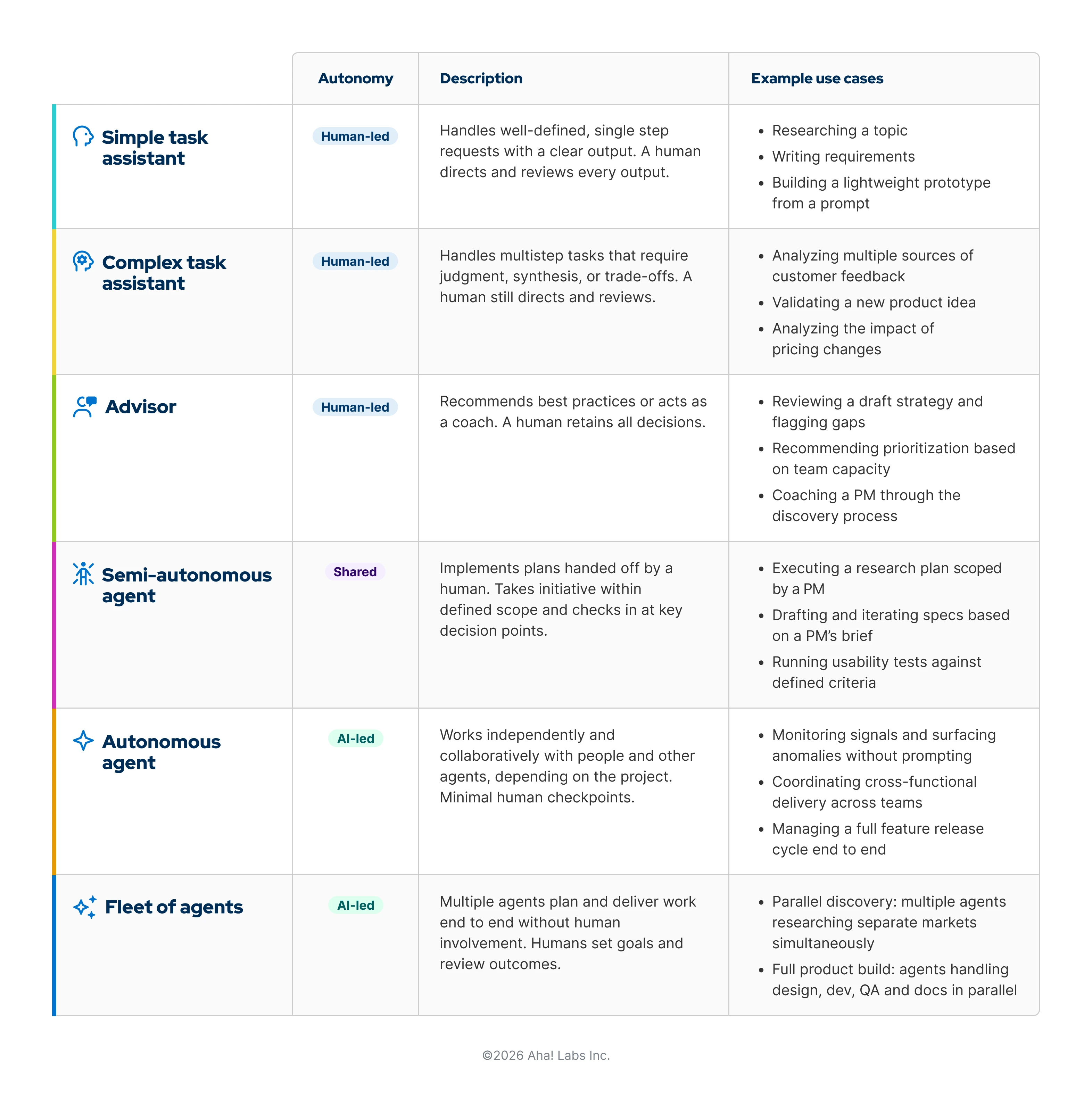
The following table highlights what can be done with AI, listed in order from the least supportive to the most active — ultimately ending with fleets of agents autonomously doing work with little product management intervention.
The reality is that you are likely already using AI in multiple ways. You are also probably exploring where you might also gain additional leverage. Where you sit on this AI usage curve — and the tools put in place — dictates the extent to which AI can assist your product development processes.
The role of product managers is growing as AI fundamentally enhances what is possible.
A product manager who coordinates a team of colleagues today will increasingly coordinate a team of agents doing the same work. That shift frees product teams to focus on what AI cannot resolve: what is worth building, who it is for, and why it matters.
We have entered a new era. That is always a stressful time. The good news is that AI will make us better product builders, which will lead to software that our customers love — and that we are proud of. The work we do on a day-to-day basis will likely change. But our vision, customer understanding, prioritization abilities, and style put us in an enviable position where we can continue to thrive.
How we are building is changing. Why we are building is not. We are more powerful than ever before if we adopt an adaptive mindset and remain optimistic. That is the new psychology being internalized by the best builders.
The best way to understand this shift is to experience it. We recently launched Aha! Builder so you can create the robust prototypes and business tools your company and customers need.