What is the role of a product operations manager?
Last updated: May 2024
A product operations manager supports the teams most closely involved in the daily product development work — product management, engineering, and customer success. Their work empowers this core product team to build more lovable products. This involves streamlining processes, improving cross-functional collaboration, documenting best practices, setting up integrations, and more.
Think of product ops as centering around the "how" — how product teams build. So while a product ops manager does not actually build products, their work helps the product team collaborate, scale, and build better solutions more efficiently. This makes the entire product development process run smoothly.
Streamline product operations in Aha! software. Start a free trial.
In the right type of organization, a dedicated product ops function can bring real value to the business and team. This is especially true for large technology companies with multiple product teams and complex product portfolios.
But not all business benefit from a separate product ops function. At many companies, product managers already do the work of advocating for the product team, thinking deeply about how to improve workflows and team collaboration, streamlining processes, and determining better ways to track overall progress.
That said, if you are interested in focusing on product ops as a career, read on to learn about the key responsibilities, skills you need to succeed, and tips on how to find your first product ops position.
What are the responsibilities of a product operations manager?
At a high level, a product operations manager focuses on increasing efficiency and improving collaboration. This frees product managers (and the broader product team) to focus on building an offering that delivers on the company and product strategy.
The exact responsibilities of a product ops manager vary depending on the type of organization and its product development maturity. But on the whole, a product ops manager concentrates on streamlining internal workflows, processes, and tools throughout each stage of product development — from strategizing and ideating to planning, building, launching, and beyond.
Specifically, this might entail creating templates for documents and meetings, establishing and maintaining an ideas portal to collect feedback, or setting up automated notifications as work progresses. A product ops manager would also be in charge of maintaining (internal) product-related documentation and onboarding new team members. Evaluating the tech stack is another vital responsibility — this ensures that the team has the right tools to collaborate and complete work efficiently.
Learn more about the responsibilities of a product operations manager:
Here are some key areas of focus for product ops managers:
Alignment — make sure the product team communicates and collaborates smoothly with other cross-functional groups
Culture — promote product development best practices and champion a strong product-led culture in the organization
Improvement — establish and iterate upon methods for gathering internal feedback for improving the product development process
Progress — set standards and metrics to track the product team's progress against company and product goals
Velocity — empower the product team to build and deliver the right releases to customers faster
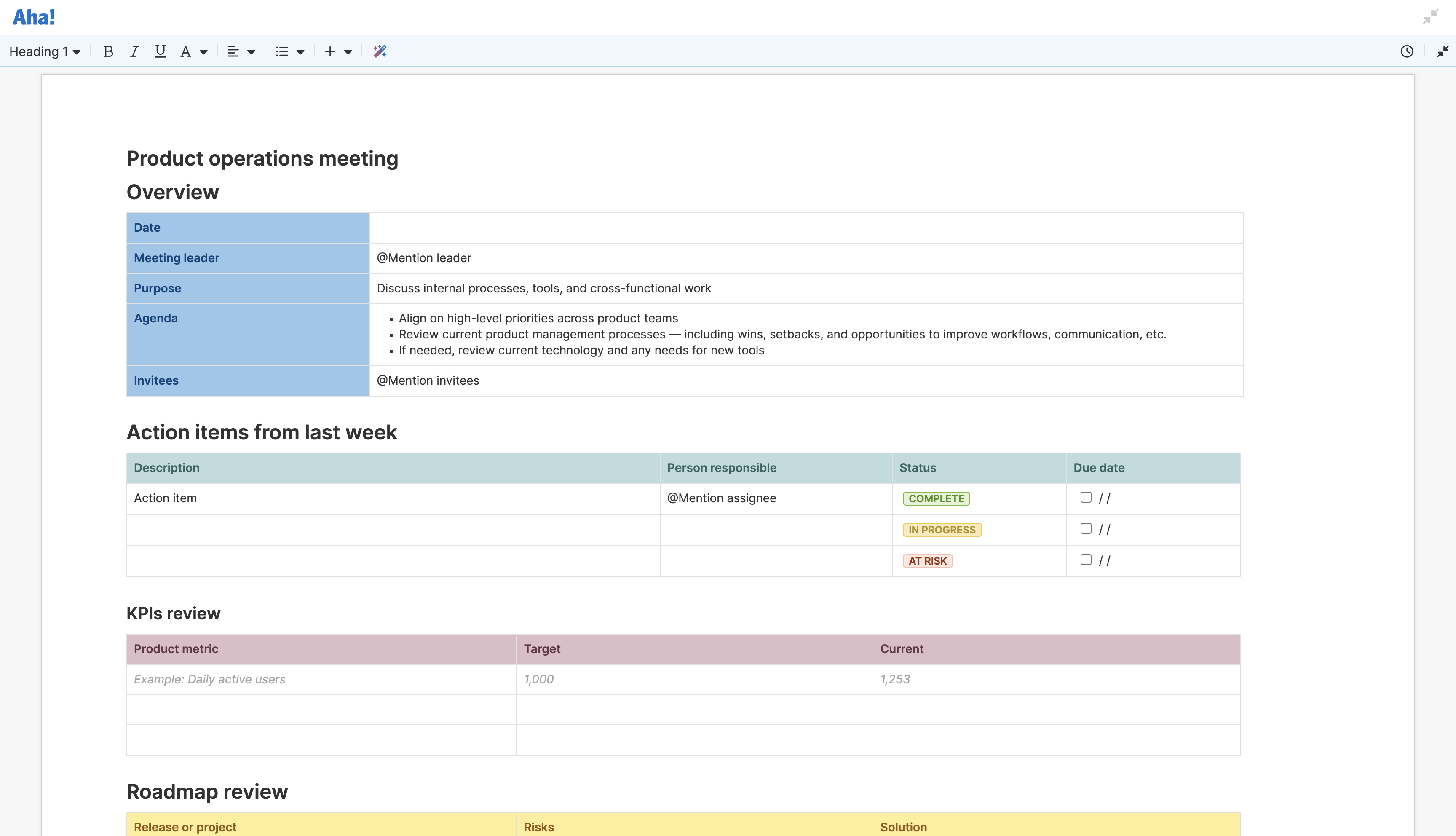
Many product ops managers also facilitate biweekly or monthly product ops meetings with members of the product team. The goal of these sessions is to ensure cross-functional alignment and identify opportunities to improve processes and tools. This product operations meeting template in Aha! Knowledge will give you a more detailed preview of what these meetings entail. Of course, you can also use it as an agenda for your own meetings.
Run better product operations meetings in Aha! software. Start a free trial.